Wednesday, April 15, 2020


The Art of Planning-Part 3 Filling in the Blanks

Introduction

In Part 2 I addressed the "nuts and bolts of planning. In reading and re-reading that post I realized there was some detail left out. I want to use this post to try and fill in the missing pieces, or in other words fill in the blanks that were left out.

Beginning to write the Season Plan

When you sit down to write your seasonal plan I think it is imperative that you know how you are going to divide up your season. For example I would look at what meet will be the main meet which you will ultimately prepare your swimmers to peak, or taper for in hopes that they will achieve their goal times and swim really fast. Once you have selected this "championship" meet you can take the following steps:

Step 1 The Start
1.  Calculate the number of days in your season. Start by working backwards. Count the number of days from day one of the championship meet back to the first day of the start of your season. This becomes the number of days that you will plan for in the given season. Most seasons will last anywhere from 71 to 120+ days. In American swimming the "short course" season typically runs from September to March or first of April. a typical high school season can be anywhere from 60 to 82 days. A few high school activities associations have seasons that last over 90 days.
2. Determine what your seasonal goals are going to be.
3. Determine, and select the days and dates of your holidays/training breaks, the competitions you want to use as stepping stones to the championship meet.
4. Determine the training phases or periods, and their length and what you feel you need to focus on.
5. Determine how much volume you want to achieve during each of these phases. 

Step 2 Writing the Plan
Before writing the actual plan I recommend that you create your own monthly blank calendar, or obtain a monthly blank calendar either online or at your local Office Depot or Staples. It is easy to create one of your own using Google Sheets or Microsoft Excel or another spreadsheet program. I have attached a sample at the end of this blog. The advantage to creating one yourself is that you can organize and put the detail on your calendar that you feel is important.

The next step is for you to divide your season into the training phases/periods that you are comfortable with and are important to you. There have been articles published by US Swimming and ASCA on the phases that you can use. You may have to search for the articles but they are on their respective web sites. I use the following terminology to describe my seasonal plan's phases:

1, Preparation Phase
2. Endurance Phase
3. Specialty Phase
4. Transition Phase
5. Peak Performance Phase

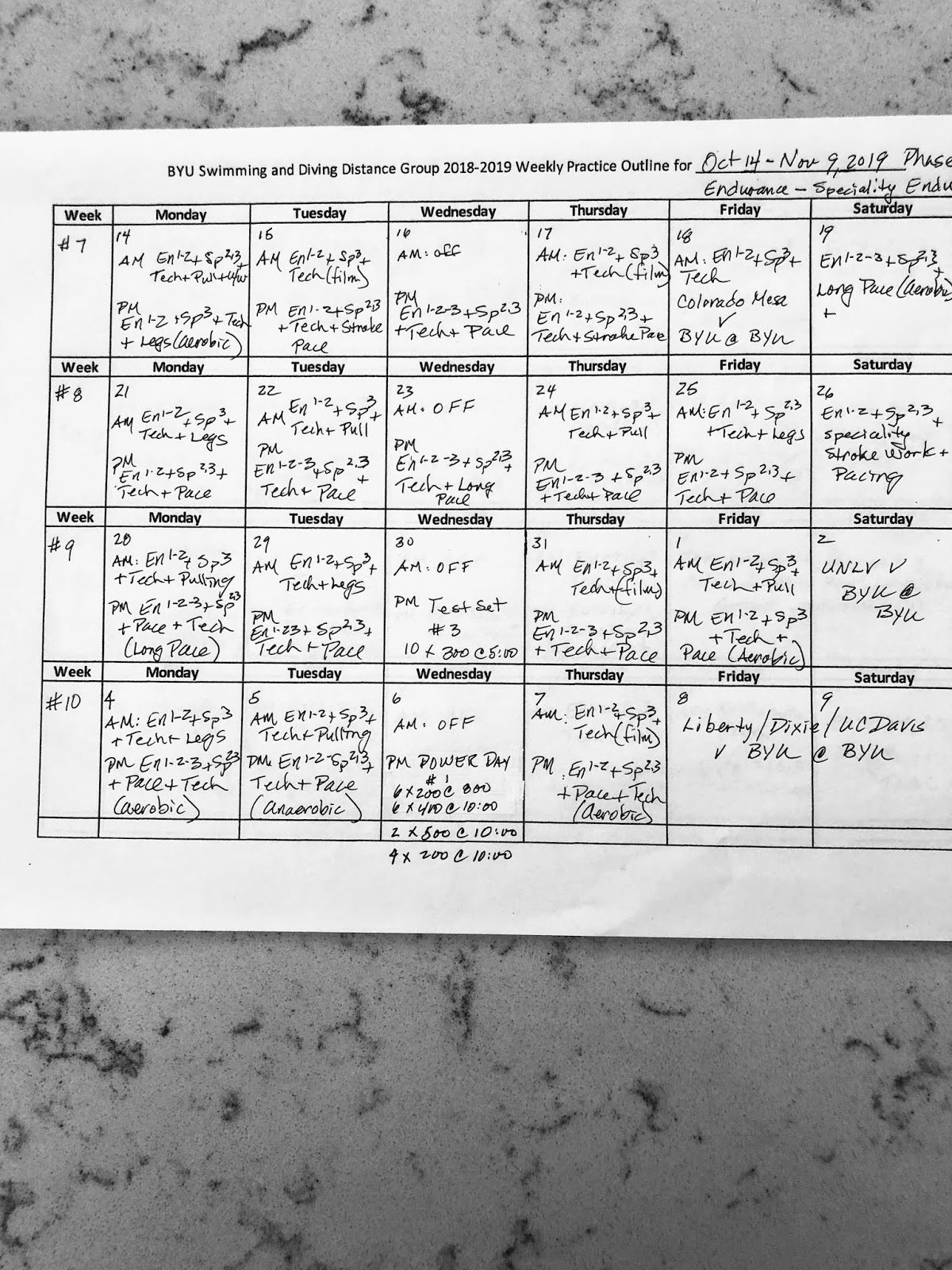
I have attached two examples of how I do things. I am posting so that you can get a general idea. I learned, and adapted this format from two coaches that I highly respect-Dick Hannula and Jon Urbanchek. If you will look at Figure 1 this is the page in my graph paper book where I list important dates and the number of days to the key meets in the season. At the bottom of page one I list the Phases for the 2019-2020 College Season. For this season I had two time periods where we rested for a key meet. The first Peak Performance period was for the University of Missouri Invitation and the second Peak Performance Period was for our Conference Championships.

On page two of Figure 1 I begin the day to day plan and the training categories that I use. This is the part of the planning process where it is important to be well thought out and planned. When you write a basic outline for what you are going to be working on you must be aware of important dates. These may include the dates of meets, when the holidays and breaks are going to be. This part of the plan must also be flexible enough to allow for individual adaptation for the student-athletes. For example if a student-athlete has met a goal time before the "big meet" then the plan may need to reflect an change it what you are going to do for that athlete. The same is also true in reverse. For instance if a student-athlete gets injured, or sick and misses significant practice time the plan must reflect changes that you will make to address the long term health of the student-athlete. The plan should then reflect you changing the training categories to aid in bringing the student-athlete back to full health.

Figure 1 Sample Seasonal Plan Outline

Figure 2 is the monthly handout I give to the student-athletes so that they know what we are going to be working on. On these "blank' monthly calendars I list the training categories, primary sets and any test sets that the athletes will do. I think this is important for the student-athlete to see and know where they are headed and what they are gong to be doing so that they can set daily practice goals. I also like the student-athletes to be able to see what phase we are in and the dates of those phases so they can set, and adjust their goals as needed. There is also a chance, and I mention this because I have experienced this, that once you hand out this monthly calendar a student-athlete might find in convenient to miss on a given day because they do not want to do what is scheduled. People and people and will take short cuts, but this is where you must educate them on why they did to do what you have planned. You can do it. If you have educated your student-athletes on the need for these sets, the majority of the swimmers are going to look forward to the chance to to something that will help them achieve their goals.

Figure 2 Monthly Seasonal Plan September 16-November 9, 2020

Conclusion

I will finish this blog post on planning by summarizing the primary things that our plan should be:
1. Set up your plan based on where you want the club and swimmers to be-at the end of the year, or at the end of 2-3-4 years.
2. The plan should reflect your training and coaching philosophy.
3. The plan should be designed for your student-athletes and where they are in their development. 
4. The Plan must be written to help the student-athlete achieve their goals and make progress form year 1-2-3-4 etc....
5. The Plan must be well thought out, organized, adaptable and flexible to the club and student-athletes changing and growing needs.
6. The Plan should be evaluated and updated as needed based on the individual student-athletes needs

One final thought on planning. I never use the same plan twice because student-athletes change and grow, times change and each year is an entirely new season. Good luck and good planning.

Wednesday, April 8, 2020

The Art and Importance of Planning Part 2-the "Nuts and Bolt"


“You can't plow a field simply by turning it over in your mind.”
Gordon B. Hinckley


Introduction

I love the introductory quote above because in this post I want to share the "nuts and bots" of planning. In part one of this post I tried to lay the ground work for understanding why seasonal, and even quadrennial planning is important. I this post I hope to provide you with some things that I have found helpful to me in my planning. Please remember that this is one man's experience. I believe, and recommend highly, that it is a good idea to search and seek out several opinions about planning from a variety of coaches. Then pick and choose those practices that you find helpful and that fit your particular circumstances.

Prologue

In my second job as a young coach I recognized the need to know, and have in place a daily practice plan. I really did not understand in my beginning years how to plan out  full season. I knew how to plan out a weekly plan, but to think in terms of a month, or two or three that was just not in my understanding or practice. My first exposure to seasonal planning was during my fourth year as a coach of a newer US Swimming Club in Orem, Utah. I was visiting with a prominent local coach who had a lot of experience and he shared with me his plan. I did what a lot of coaches do and that is I borrowed his plan and made it mine. I simply took our his information and inserted mine. This worked okay, but was not as effective as it should have been because the achievement level of swimmers of the coach I consulted with was not the same as those I was coaching.

As I gained more experience I had the chance to attend my first ASCA World Swim Clinic in Las Vegas, Nevada and I was able to talk to a lot of coaches and gain get some answers and directions about planning. This is where I first heard about quadrennial planning. At this ASCA World Swim Clinic, I also took the Level 3 Coach's School. During this school I realized the need to have a well thought out, systematic and designed plan for teaching and conditioning swimmers. This plan needed to include such things as particular goals for where I felt the team needed to at various time periods within the competitive calendar. I realized the need to establish a proper meet schedule so that I could gauge the effectiveness of my teaching and conditioning plan, as well as provide my swimmers with the opportunities to see their progress towards their goals (this will be the subject of another blog because it is a vital part in planning). So after this ASCA World Swim Clinic I returned home and began to plan in earnest.

What I began to do is use our yearly week long trip to my in-law's home to set my goals and to plan. This trip typically was taken after the summer long course season. This worked very well, but I felt I was still missing something. The way I planned all changed when I was hired to be a teacher, and the Head Swimming Coach for Woodrow Wilson High School in Tacoma, Washington, as well as an Assistant Coach to work with Dick Hannula at Tacoma Swim Club. Coach Hannula helped me make a huge change in my planning practices. What I quickly learned from Coach Hannula is that you have to plan long term. You have to look at the swimmers from their start to their finish. What he would do is to look at a swimmer who was in the 9th grade and make a four year plan for them. I also learned that this plan was a progressive, logical and well designed plan to address the growth and maturity of the swimmer over time.

My first experience in seasonal planning came when I was flying home from my first Junior Nationals with Coach Hannula and Tacoma Swim Club. Coach Hannula had arranged for us to sit next to each other on the flight home. It was about a three hour flight and I recall, no long after the flight was in the air, Coach Hannula took out of his carry on an engineering graph paper spiral notebook. Prior to the meet he had already printed off the meet schedule for the coming short course season, and he handed this to me so we could use it at an appointed time. We quickly went through the names of all the returning swimmers and the new ones who had achieved the criteria to be on the National team. He then guided me through the things that he felt we needed to emphasize for next year to make progress. New seasonal goals were set and written down in the book. We then went through a day to to day plan of teaching and conditioning plan for the swimmers. As part of this planning we also wrote down the meets that would be used as benchmarks for us to gauge the effectiveness of our teaching and conditioning. By the time we landed the new season plan was made and we were on the same page as to where we were headed.

The "Nuts and Bolts"of Planning-where the rubber hits the road.

To refresh your memory, and I mind. Here are some of my best practice ideas about planning that I mentioned in Part 1:

1. Determine where I want the TEAM, and each swimmers to be at the end of a season.
2. Determine what skills that my staff and I will need to emphasize and teach to help the swimmers get to where I what them to be at the end of the year. Included in skills are such things as techniques, and the "Processes" you want them to learn-understand-apply.
3. Determine what are the physical conditioning categories that are to be used to help prepare the swimmers to perform the skills and processes needed to achieve the ending results wanted. This includes in water training categories-Aerobic Endurance, Threshold, Speed work etc. It should also address what types of dryland exercises are to be done to enrich the swimmer's ability to progress toward the end results. It can also include things like mental strength training, and team building activities to provide support to every member of the team as THEY progress together toward the end results.
4. Determine the meets to attend that will be used as assessments, or "stepping stones" in their progress toward the end of the year meet. Each meet should be selected with a specific purpose in mind. For example, select a meet at which the swimmers should be able to perform a given number of underwater kicks off each wall to eventually get beyond flags by the final championship meet at the end of the year. Each meet can have a designated focus that will allow you and your staff to gauge the effectiveness of your training and teaching.
5. Determine the phases of the season, their length and the focus of each; Aerobic base, anaerobic, threshold, speed, technique etc...
6. Put it on paper. Prior to putting the plan to paper I like to put the outline of the plan on a large white board complete with dates and as much detail as possible. I think this allows the staff to see where we are headed, and how we are going to get there.

Once all of this is compete, and the plan is written. You should communicate the plan to the swimmers. It is very important as you start each year to teach the swimmers and inform them of where they are going, how they are going to get there, and what things they are going to be doing to get to their end result. I recommend you print off a blank monthly calendar and fill in the blanks with what you are planning to do each day during a four week period of time. It is very important that you evaluate and re-evaluate your plan as the days progress through the plan. Remember the plan must be flexible and adapt to changing circumstances. You should be prepared for any scenario as things circumstances can change. The pool may be down, athletes get sick and/or injured. Sometimes your swimmers will achieve goals sooner than expected and you will need a flexible plan that can address and adapt to a change in goals for the athlete. 

Epilogue

Planning is so critical to the success of the coach, athlete and the team. Writing a great plan takes time and experience. I recommend that you put your plan in some type of notebook, or even use a lap top. I am old school and prefer to write it down on paper. For me I have found it helpful to both write and see the plan before finalizing it. I believe it is also important to save your plans and refer back to them. I have over 30 years of saved plans. I do look back at them periodically to see if I am missing anything, or to look at what worked in a particular year. Sometimes you will find "hidden gems" that might be helpful in writing a new plan, as well as things that you might want to use but really did not work. Do not rush your writing your plan. Take your time and thoughtfully consider your plan. Above all else remember you are planning for the success of the athlete and team, not you. Success to you.

"Planning is bringing the future into the present so that you can do something about it now." Alan Lakein


Friday, March 27, 2020

The Art and Importance of Planning Part 1

"In preparing for battle I have always found that plans are useless, but planning is indispensable." President Dwight D. Eisenhower

Introduction

Given that most of us, if not all of us are isolating ourselves whether by choice or Executive Order. I was thinking of how to best use my time in my home. I thought that now would be a good time to plan the coming season. As I began to think about the coming fall season I thought it might be a good topic for a blog post to share my thoughts on planning with you. I hope that you will feel free to share any best practices on planning that you have picked up.

I love the headline quote by President Dwight D. Eisenhower, who during World War II was the Supreme Allied Commander responsible for the planning, implementation, and carrying out of Operation Overlord. This operation became known as the Invasion of Normandy or the D-Day Invasion. This operation was the largest amphibious invasion in the history of the world. General Eisenhower had to plan the invasion that would coordinate the attack using roughly 1200 planes, 5000 plus ships, and over 160,000 troops. General Eisenhower had to make plans with his supporting staff of Generals to coordinate every aspect of the invasion in order for it to be successful and ultimately bring about the defeat of Nazi Germany.

In our various responsibilities as coaches we are a lot like General Eisenhower. We have to coordinate the training, the teaching of technique, and meet scheduling to help our measure the development of our swimmers as they ultimately progress to the championship meet at the end of the season. True our swimmers are not going off to a war, but they are going to be competing at swimming meets and striving to do their best. Having a well thought out, structured, coordinated and organized seasonal plan will help create the opportunities for our swimmers to be ready to go into battle to achieve their goals.

Preparation for Writing the Plan: Understanding by Design

Before writing a plan I would high recommend that you read the book, Understanding by Design written by Grant Wiggins and Jay McTighe. You can purchase this valuable resource book on Amazon in paperback for anywhere from $18.00 to $22.00 in paperback. While this book addresses teachers and how they can effectively help their students gain understanding, which is more important than just learning. The concepts and practices Wiggins and McTighe propose are very applicable to us in coaching swimming.

In their book they identify three stages that teachers and/or curriculum designers must take into consideration before writing and designing curriculum and lesson plans. The three stages are:

Stage 1. Identify desired results for the students. Where does the teacher what the students to be at the end of the year.
Stage 2. Determine acceptable evidence of the students. In other words what constitutes, or defines what the student has come to understand and learn.
Stage 3. Plan learning experiences and instruction that demonstrates a student's progress toward the desired results.

Stage 1 Identify desired results (Characteristics)
1. What should participants hear, read, view, explore or otherwise encounter?
This knowledge is considered knowledge worth being familiar with. Information that fits within this question is the lowest priority content information that will be mentioned in the lesson, unit, or course.

2. What knowledge and skills should participants master?
The knowledge and skills at this sub-stage are considered important to know and do. The information that fits within this question could be the facts, concepts, principles, processes, strategies, and methods students should know when they leave the course.

3. What are big ideas and important understandings participants should retain?
The big ideas and important understandings are referred to as enduring understandings because these are the ideas that instructors want students to remember sometime after they’ve completed the course.

Stage 2 Determine Acceptable Evidence (Characteristics)
This is the assessment phase where the teacher will look at the instruction he/she is giving and will assess the student's understanding of the items he/she is teaching that will help the students gain a final understanding of the curriculum at the end of a given unit-the enduring understandings.

Stage 3 Plan Learning Experiences and Instruction (Key Questions)
1. What enabling knowledge and skills will the students need to perform effectively to achieve the desired results?
2. What activities will need to be taught and coached, and how should it best be taught, in light of performance goals?
3. What materials and resources are best suited to accomplish these goals?
4. Is the overall design coherent and effective?

Application to the Writing a Seasonal Plan (My Best Practices)
Here are the steps I go through in writing my seasonal plans
1. Determine where I want the TEAM, and each swimmers to be at the end of a season.
2. Determine what skills that my staff and I will need to emphasize and teach to help the swimmers get to where I what them to be at the end of the year. Included in skills are such things as techniques, and the "Processes" you want them to learn-understand-apply.
3. Determine what are the physical conditioning categories that are to be used to help prepare the swimmers to perform the skills and processes needed to achieve the ending results wanted. This includes in water training categories-Aerobic Endurance, Threshold, Speed work etc. It should also address what types of dryland exercises are to be done to enrich the swimmer's ability to progress toward the end results. It can also include things like mental strength training, and team building activities to provide support to every member of the team as THEY progress together toward the end results.
4. Determine the meets to attend that will be used as assessments, or "stepping stones" in their progress toward the end of the year meet. Each meet should be selected with a specific purpose in mind. For example by meet number on the swimmers should be able to perform underwater kicking beyond flags.
5. Determine the phases of the season, their length and the focus of each.
6. Put it on paper.

Summary and Final Thoughts

To summarize this lengthy post here are a few ideas to consider as you plan. I think it is important that the plan reflects the Head Coach's philosophy. If a Head Coach does not have a defined philosophy that needs to be decided upon, written and/or communicated to the staff. It is the responsibility of the Head Coach to gather around him/her assistant coaches who will buy into and support that philosophy. I believe it is important that the Head Coach put on paper his/her plan for the staff to follow. He/She must communicate the desired end results to the staff. However, all coaches need to be involved in the creation, publication and implementation of the finalized plan so that as a program the end desired end results can be achieved. I recommend gathering together in a planning meeting, somewhere that has a large whiteboard, or chalkboard so that the dates of the season can be written and every aspect of the plan calendared. The Head Coach must conduct, and lead this meeting. The staff then plans together the phases of the season, the meets to attend. Every aspect of the season needs to be calendared to help the TEAM, staff and swimmers arrive at the end results. When the final plan is agreed upon the individual coaches can develop a plan for their respective groups and then each coach publish and communicate the goals and plans to the TEAM and swimmers.

I love this saying, "If you fail to plan. You plan to fail". I believe this is a true statement however trite and over used it may be. I believe in planning seasons and especially in planning for multiple years. One time I listened to one of our country's National Team Coaches, I do not recall who it was at this time other than I took his advise to heart. That advise was that as coaches we needed to have a four year plan based on the Olympic Cycle. After hearing this I thought, four year plan you have got to be kidding. However I thought I would try it. So for the 2004-2008 and then again 2008-2012 I actually put together a four year plan for the group of Senior level swimmers I was coaching. During both cycles there were two athletes from our club who qualified for the Olympic Trials. Planning works! Do it!

Recommended Reading

Understanding by Design, written by Grant Wiggins and Jay McTighe. Published by Association for Supervision and Curriculum Development, Alexandria, Virginia.

The Swim Coaching Bible Volume II. Edited by Dick Hannula and Nort Thornton, Chapter 8 Planning for Success pp 85-121. Chapter written by Coach Stephan Widmer.

Next Week's post Part 2 Ideas on the Nuts and Bolts of Planning and Implementation

Wednesday, March 25, 2020

What a Taper is and What a Taper is Not

Introductory Note

In no way am I an expert on this subject for like many coaches the Peak Performance Phase, also known as the Taper Phase, is not an exact science. So here you will find a brief article written about my opinion about the Peak Performance Phase. Please feel free to comment and express your opinion as I believe that your sharing helps me to learn and grow.

Peak Performance Phase

For this blog post, which I admit should have been done in January, I want to share my opinion about what taper is and what it is not. In reading the many books about coaching swimming the taper is probably the least understood and the most tricky to deal with and get right for everyone at the same time. A good example of this is the time I once had a team of 20 swimmers who had qualified for Sectionals the previous winter.

After the Sectional meet in March, I was very excited for the Summer Long Course Sectionals because i just knew we were going to have a great meet and see qualifiers for the next level meets at the summer sectionals in Oregon. After a two week break in early April we began in earnest to prepare for Long Course Sectionals. During this time I kept a meticulous roll. However by early June the attendance for all practice sessions was less than ideal. The person with the best attendance was at 80% with most of the Sectional qualifiers at 50 to 60%. A few were in the 20s. I called a special team meeting to discuss the swimmer's attendance. As a teacher and head club coach I fully understand the need to miss practice sessions for AP tests, end of year concerts,family responsibilities and so on. However to have a team wide attendance percentage in the 50% range was not acceptable. So I made a decision and announced that given their level of commitment there would not be a "taper" this summer because I felt they would have nothing to taper off of. So for this particular summer we literally swam through every meet. For Sectionals I gave them three days rest-two days before we traveled and the day of travel. We arrived in Gresham, Oregon ready to swim and do our best to compete. My only expectation was that we would do our best given that we had not had a "taper" phase in our training plan.

At this Sectionals something happened that I did not expect in that we had people making second swims and life time bests all throughout the event list. We even managed to have a team member hit an Olympic Trials qualifying time. At this point it was the best total performance by any of the teams I had coached. To my surprise, the next week we were back in Utah and competed at the State long Course Meet and the swimmers where even better, most of them posting times that were faster than they had been at sea level the previous week. I was really impressed by the swimmer's performances and was left scratching my head, wondering how did this happen? After the meet, which we were able to take first place, several coaches congratulated me on the way to young people performed. I jokingly said to one coach if they are going to swim that way on a no "taper" I will never run another taper.

Since this time I have tried to stop using the word "Taper" because of what the swimmers think a taper is. I have tried to educate the swimmers to think of the taper more as a peak performance period. I will explain later why I have stopped using the term taper and changed to using the phrase "Peak Performance". The topic of this blog is "What a Taper is, and What a Taper is Not." The actual idea for this blog is not mine as I first heard about the topic from my coach and mentor Dick Hannula coach founder of the Tacoma Swim Club, and his good friend Nort Thornton, It was Coach Thornton of the University of California, Berkeley who published a paper to his swimmers by this same name and Dick added to it for his swimmers.

What a Taper Is

Generally speaking, in their planning most coaches will use the last three or four weeks of a given season to use as a taper period. Here are a few thoughts from the ideas and thoughts from both of these two great coach's. A taper is:

1. A time period of decreasing workloads in an effort to maximize muscular adaptation
2. A time period of increasing strength and endurance
3. A time period of fine tuning the swimmer's focus on mechanics, meet and race preparation.
4. A time period of increased focus on three "R's" of swimming-rest, rehearsal and relaxation in order to reduce psychological, emotional and mental stress on the swimmers.
5. A time period of peak performance

What a Taper Is Not

Every swimmer looks forward to the "taper" period because of the euphoric feelings they have given the above items about what a taper is. However, many swimmers have a misconception of what a taper is. Here are five things that a taper is not. A taper is not:

1. A period of no work.
2. A period of no intensity.
3. A period of no yardage.
4. A period of absolute rest.
5. A period to play.

Explanation and Discussion

When I first began coaching I never worried about a"taper" too much because I was coaching all the swimmers who were 10 and under. It was not until I began to coach older age groupers, 12 and up that I first began to plan a "taper".  At this formative point in my career I realized I needed help. So I read, wrote letters, there was no such thing as email at this time, made phone calls to coaches I admired, and spoke with other coaches at meets to get their opinions and advice. Of course I believe experience has been my greatest teacher. I believe you can take all the written words you read, and all the words of advise you are given. Then you should go through those words and apply them in your coaching. In the long run it is this application of advice that will help you learn. I have learned more from the application of advise, the implementation of the plan and an evaluation of the results than just through sheer reading and personal contact. Here are the things I have learned through experience:

1. Each season must be well thought out and planned. The season should be divided up into phases based on the swimmer's gender, age, maturation, and skill level. This means that in many cases you will need to have plans that are flexible and varied to take into consideration the individual needs of the swimmers.
2. Swimmers need to be educated on what exactly a taper is and what it is going to look like in the plan. There are far too many swimmers who have a wrapped understanding of what a taper actually is. For this reason when I have written my seasonal plans I like to use the same wording as Coach Hannula-"Peak Performance" Phase. I have found using this phrase has helped the swimmers come to understand that during the last ten days to five weeks of a given seasonal plan we will be working to "peak" our physical, technical and mental skills for maximum performances at the championship meet.
3. The Peak Performance phase must be well planned and flexible enough to address the individual variations among the swimmers.
4. The Peak Performance phase needs to prepare the swimmers for any competitive situation they may face. The swimmers must be prepared for the events they will swim, the meet environment, and all aspect of the championship format. While it is challenging to simulate the environment of the given pool that the championship meet is to be held at the coach can prepare the athletes for their events. I really like what Coach Bill Sweetenham recommends in his book, Championship Swim Training. Coach Sweetenham recommends that swimmers be given sets that would allow the swimmers to use the exact timing, stroke rate and tempo, walls (turning) that they would for each segment of their races. In these "race pace" sets or swims the swimmer should think of these sets as a "dress rehearsal" for the championship event.
5.  The Peak Performance phase needs to bring the entire team together for a common cause-performances at the highest levels possible for all team members. The Peak Performance Phase should bring the team together with everyone understanding they need to sheer, encourage and compete to achieve their individual goals and the team goals. This phase should bring the teams long preparation to a single focus point for maximum performance.

Recommended Reading

I have found the following books to be particularly helpful in learning about how to plan and implement an effective peak performance phase.

Championship Swim Training, by Bill Sweetenham and John Atkinson
Science of Swimming Faster, by Scott Riewald and Scott Rodeo
The Swim Coaching Bible-Volumes I and II, Edited by Dick Hannula and Nort Thornton


Friday, November 15, 2019


Friday, 15 November 2019

Coaching Underwaters-The "Fifth Stroke" in Swimming Part 2.


In my first post about this issue I mainly covered the "how to" of coaching underwaters. For this post I want to go continue with the subject of underwaters, but take one step further and discuss in what events we as coaches should have our kids use this valuable tool. 

Illustrated importance of the underwater kick in a few selected races. 

1.  Michael Phlps v Erik Vendt
2.  Katie Ledecky's 800 Free from 2019 World Championships
3.  Caleb Dresell's 50 m Free 2019 World Championships
4.  Katie Ldecky's 800 Free from London

I choose these races because if you watch the winner in each race they use the fifth stroke very effectively to generate, and sustain momentum. From Caleb Dresell's 50 m Free to Michael Phelps 400 IM to Katie Ledecky's 800 Free, each of these great swimmers use the fifth stroke in different ways.

Discussion: Whether it is important to use underwater kicking in the longer races, or not use? 

From the videos we can surmise that it is important to use underwater kicking off every wall. I believe the race that makes this point very powerfully is Katie Ledecky's 2019 World Championships 800 m Free. If you watched that clip you witnessed Quadrel the Italian swimmer pass Katie at about the 500 m mark. At that point Katie, who had withdrawn from several of her signature events due to illness, and had been treated for dehydration. Katie stays with Quadrella, and gains on her between 600 m to 750 m and then on the last turn Katie blasts off the last wall using her strong underwaters and blows away Quadrella to win her 4th straight World Championships title in the 800 m Free. How did each of these very talented and disciplined swimmers to what they did?

Keys to being able to use the underwater kicking relies on:

1. Discipline
2. Superior conditioning
3. Doing all the little things right, which leads to doing all the big things right
4. Belief in themselves and the use of underwater kicking

Discipline

Every swimmer who desires to learn to use the underwater kick must discipline themselves in practice. They MUST use the underwater kick at all times-from warm up through to main sets, to test sets and so on. Never can the determined swimmer quit or slack on using underwater kicking. Swimmers must practice perfectly, or as near perfect as possible to achieve the desired results, that of being able to use underwater kicking in tight races as did Michael Phelps against Erik Vendt, or Katie Ledecky did against the world, or Caleb Dresell did in a tough 50 m Free field.

Superior Conditioning, doing the little things right, and belief in themselves

As coaches it is up to us to so organize our practices to help the swimmers be able to learn and do underwater kicking. This means that we must expect the swimmers to us the skill at all times and insist that they do all the little things correctly at all times. We must insist on tight streamlining, and strong push offs, off every wall regardless of where the swimmer is at in the workout-warm up, drill set, main set and so on. We must insist that the swimmers keep their head and body in alignment and build the fly kick out of each wall. We must provide the swimmers with dryland exercises that will strengthen the core, enhance functional movements that translates from land based endurance and strength to water based endurance and strength. We must provide the swimmers with effective practices that will help the swimmers be able to use underwater kicking without thinking about it. As coaches we must build the swimmer's confidence in themselves and their skills so that they are confident in being able to use underwater kicking to be successful.

Recommendations

My opinion is that our swimmers should use underwater kicking in all their races where it is legal to do so. The breaststroke is the only one where you get one dolphin kick only, so no underwaters here. I like to team the swimmers to use the following number of kicks off every wall:

1. 50-100-200: 4 to 6 dolphin kicks off walls before transitioning into their regular stroke
2. 500 on up: 2-4 dolphins kicks off walls before transitioning into their regular stroke.

In order to help the swimmers be able to do this underwater kicking must be trained using sets that help give confidence in the skill to the swimmers. See Part 1 of this topic for a few sets and other recommendations. To help with push offs I like to do the following:

1. Resisted tubing push offs
2. Vertical leaping off the bottom of pool trying to get up as high as possible. This an especially good exercise to do with a weight belt on
3. Give swimmers a point beyond flags to hit within each swim/set o n their breakouts.

Conclusion

I believe that using the fifth stroke makes the swimmers faster, more efficient between the walls and will enable them to get to the next level in their progression. Please remember that it is important to start out small and gradually add more skill and higher expectations. I hope these few thoughts have helped. Please feel free to comment back as I learn from your feedback and input.


Thursday, November 14, 2019

Thursday, 14 November 2019

Introduction

This blog post is meant to share one coaches ideas about underwater fly kicking,or what has become known as the "Fifth Competitive Stroke". I do not know everything about this great tool, but have been looking at several research papers that address the underwater kicking. I hope you read it and can use the information to formulate your approach to this skill. Enjoy.

Coaching Underwaters-The "Fifth Stroke" in Swimming.

With the advent, or rather the adoption of underwater butterfly kicking starting in the late 1970s, there have been a large number of research papers published about what is considered to be the "fifth stroke" in competitive swimming. The underwater fly kick typically was utilized by those athletes swimming the backstroke and then butterfly strokes. From Jesse Vassallo, who is credited as being the first swimmer to use it in competition, down to swimmers like David Berkoff Neil Walker, Lenny Krayzelberg, Misty Hyman, Natalie Coughlin, Ryan Lochte and Michale Phelps each have used the underwater fly kick to help them win numerous titles and Olympic Medals of many colors.

Since Jesse Vassallo, the underwater fly kick has been refined, as needed due to rule changes by FINA and US Swimming in an effort to safe guard swimmers from pushing the limits of their breathe holding capacities. Today the maximum distance an athlete may travel is fifteen meters under water off any one wall of the pool. Today competitive pools must be marked with a well defined 15 meter mater at both ends of the pool, and lane lines typically have a different colored, or a series of different colored doughnuts to clearly show the 15 meter mark.

Researchers, like Peter Clothier et al in their research entitled "Underwater Kicking Following the Freestyle Tumble Turn" (2000) looked extensively at the value and validity of using the underwater kick. Two significant findings by these researchers were that: 1. There is less decrease of velocity using the underwater fly kick compared to using the freestyle kick off the start and the turns, 2. The velocity generated off the start and the turns is sustained more with the underwater fly kick in comparison to the freestyle kick. The primary strokes that the underwater fly kick is used in backstroke, butterfly and now more freestylers are using the underwater fly kick. Caleb Dressel uses the underwater kick in all freestyle events and does so very effectively. He is dominating in the 50 free and uses the underwater fly kick to set the pace for his race of his start and turn.

Questions for consideration

1.  In what events should the underwater fly kick be used?
2.  Can the fly kick be effectively used in events longer than 100 or 200 yard races?
3.  How do we effectively train for using the underwater fly kick?


Training the Underwater Kick

Since the days of Jesse Vassallo, coaches have typically kept the fly kick reserved for events shorter than 200s. However recently more distance swimmers have begun to use the underwater fly kick to help them maintain tempo and and even stroke count throughout a distance race-500 yards and up. So how do you train to use the underwater fly kick in races. Here are a few recommendations:

1. Work on a swimmer's streamlining and their ability to hold a tight stream line for a given amount of time. Streamlining is a MUST! if a swimmer will not streamline tightly underwater then they will negate the benefit of using the underwater fly kick. A swimmer's streamline must be tight and long like a "torpedo".

2. Work on strengthening the core and increasing flexibility in the hips, lower leg, and the ankles.

3.  Strengthen and build the swimmer's vital capacity. There are multitudes of experience and research to indicate that there real safety concerns with performing/using the underwater fly kick. There have been a number of "shallow water" drownings in recent years due to swimmers passing out while trying to hold their breath during training in performing underwaters. Underwater fly kicking should be used in every freestyle, butterfly and backstroke events. Even the 500 on events can benefit from the use of underwater fly kicking. A great place to start training swimmers to use the underwaters in the longer races is to teach them to get feet beyond flags before their first breath and stroke.

4. In teaching and conditioning swimmers to use underwaters, go by the "Plus 2 Rule". The "Plus 2 Rule" was implemented by Bob Gillett, who was Misty Hyman's coach. he would instruct Misty when she was training her underwaters, or swimming the butterfly, that is she wanted to take 6 underwater kicks in a race in a meet, then she needed to take 8 underwater kicks each wall in practice. Going 8 in practice with great form will translate to going 6 in a meet. Teach, and expect the swimmers to do the fly kick on their side. They will move faster through the water on their side.

5.  Start small and work big. Have athletes start using underwaters for 5, 10, 12.5, 15 meters. Get the swimmers to do these shorter distances correct first before moving on to longer distances. A 100 yard race, or more done correctly to 5 or 10 meters will lead to a swimmer gaining confidence that maybe with a little more work they can go 12.5 and then hit 15 with practice and time.

Sample Underwater Training Sets

Kick Set

1.  24X25 kicking 12.5 to 25 yards off each wall. Start small and get 12.5 down and progressively move to kicking underwater for 25. I usually start by doing one under and one over, and work up to two, or three under and one over. As for send offs I allow enough time for the swimmer to re-gain their breath and then go again.

2.  Kicking and turns combined:  6 kicks at wall+fast turn and then underwater kick to 12.5 or 15. I like to add breakouts on a second round having swimmers going fast to the 15 or 20 and a fast "no wall" flip turn at flags.

3. Kick and Swim set: (my personal favorite)
a.  Kick 12.5 fast+12.5 easy kick building to Kick 12.5+Swim 12.5 fast
b. Do this in the following rounds: 4X50 followed by 2X50 easy then 2X100 followed by 2X50 easy. The set would look like this:  Kick 4X50@45+S 2X50 Easy@45+Kick 2X100@1:30+S2X50 Easy@45 Round 2 would be Kick fast underwater then Swim easy. Round 3 would be fast kick under and fast kick on top, Round 4 would be fast kick under and fast swim over. You can vary the distance underwater from 12.5 to 15. Looks like:

Four rounds: Round 1 Fast Kick 12.5-Kick 12.5 easy both walls, Round 2 Fast kick-Easy swim, Round 3 fast kick-fast kick, Round 4 Fast kick-Fast swim. Great set.
a.  4X50@45
b. 2X50@45 Easy
c. 2X100@1:30
d. 2X50@45 Easy

4. Two, Four, Eight turn 50's, 100's 200's focusing on underwaters, breakouts and distance per stroke.

Advantages of using the Underwater Kick

1. The fly kick off the wall helps to increase and sustain momentum off the walls when properly trained. There is research to support the premise that normal freestyle kicking has more periods of drop in momentum, whereas the fly kick has been shown to sustain and increase momentum.

2.  The fly kick helps in stroke efficiency and aids the swimmer in keeping a consistent stroke count throughout a given race.

3. It is a great tool for the swimmer's tool box to help them move faster through the water and build momentum in a given race.

4. With good conditioning the use of underwaters will help the swimmer put more effort into the legs at the end of the races.

Friday, September 20, 2019

GRIT-more than just the "scratchy" stuff on sandpaper


Friday, 20 September 2019

This edition of my blog is going to be about "Grit". It is taken from, and based on a Ted talk originally given by Angela Duckworth in 2013. I have put the link to Dr Duckworth's talk below so you can use the link to view, and hear her talk. Before reading on I invite you to use the hyperlink and view her talk. This will help make this blog post more meaningful and applicable. Here is the hyperlink:


To review Dr Duckworth's talk, she begins by defining "Grit" as being:

"Grit is passion and perseverance for long-term and meaningful goals. It is the ability to persist in something you feel passionate about and persevere when you face obstacles. This kind of passion is not about intense emotions or infatuation."(Oct 3, 2017)

Dr Duckworth also states that in her experience and research it is
not the highest IQ kids, or wealthiest kids, or the best looking kids that are successful. It is those kids who have "Grit" who are the most successful. Dr Duckworth, by definition states that Grit is to have a passion and perseverance for your goals. To have have Grit means that you are "sticking with your future, day in and day out". Furthermore to have Grit is to live life like it is a marathon and not a sprint. To have Grit means to have stamina to achieve your goals, or desired outcomes. Her research was done with students in the public schools of Chicago and in other areas around the country. 

Application and Discussion


President Theodore Roosevelt, our country's 26th President once stated: “Far better is it to dare might things, to win glorious triumphs, even though checkered by failure…than to rank with those poor spirits who neither enjoy nor suffer much, because they live in a gray twilight that knows not victory nor defeat”. 

In developing grit a person must be willing to engage in new things, new processes, different challenges and tasks. A person must not fear, or shun performing any given task required. Instead a person must be willing to welcome the opportunity to work at some task that is new, different or foreign to their normal routine. I think President Roosevelt's quote about to "dare mighty things" is appropriate for developing Grit.

As coaches we can help the swimmers develop grit by challenging them, and teaching them to try new events. We should teach them the processes required by the new event. Speak to the athlete about what is expected of them in the proper performance of the new event. It is not good enough to just teach them, and talk to them about going fast. The end result is to go fast, but the processes they need to go through are extremely important in the learning to have grit process. Give the athlete measurable bench marks that make up the process to a successful performance. These can be things like give them a stroke count to hold, or tempo to sustain, or kick beyond flags off every wall on a freestyle race, use 6 instead of three underwater dolphin kicks, be within a certain percentage of a given qualifying time, and so on. A critical thing here in the development of grit is for the athlete to understand their improvement towards a given goals. By looking at benchmark expectations we can help our swimmers develop grit. 

The Art of Using Praise

According to social scientists, the use of praise does nothing more than to feed, or boost the ego. There is little learned from ego boosting feedback and evaluation. If we, as coaches want to see an increase in grit we must teach what is required and then expect those results. as we teach and give feedback, our feedback must be positive and provide sincere evaluations of the performance given. We should praise the athlete's efforts to complete the processes required. For example, a coach who has taught his/her swimmers to do their turns so that they take their first stroke beyond the flags on each wall, and they do 3-6 dolphin kicks off each wall and they are to build the tempo of their stroke into every wall. Now if a swimmer does this on 5 of 8 lengths of a 200 the coach could say something like, "You did a great job with your turns, push offs, fly kicks and tempo into the walls. You made 5 lengths of the race doing everything correct-your turns, push offs, dolphin kicks were right on for 5 lengths and then you struggled with the remaining processes of the race. Next time lets shoot for 7 fo the 8 walls by doing...."  You always want to point out what they did wrong in a positive light, for example, "Hey you had 5 turns where you streamlined well beyond flags off each wall, had tight streamline on push off, and your tempo looked good as you sustained your momentum into the walls. What you need to add now is do these very same things on the remaining 3 lengths of the race, by keeping your focus on doing things right. You can do it." 

The coach should avoid negative feedback, and feedback that feeds the ego.  For example you might want to avoid sayin, "Don't let your tempo drop off into your turns", or "You did not kick 3-6 dolphin kicks of your turns and this is why you did not achieve a better time." Keep all your feedback positive and grit enhancing. Avoid ego feeding feedback like, "You are so great! Your swim was awesome and you looked great". These statements do little to help the swimmer learn and develop grit. 


GRIT Scale
For those who are interested you can use the following link to take a test that will indicate how much grit you have, or on the funny side of things how “gritty of a person” you are. Be honest in taking the test and have a great time exploring your grit level: https://angeladuckworth.com/grit-scale/


The next link is a link to a Ted Talk by Carol Duckworth about Mindset. I addressed this topic a few weeks ago and will come back to it next time and tie Mindset and Grit together. Enjoy.